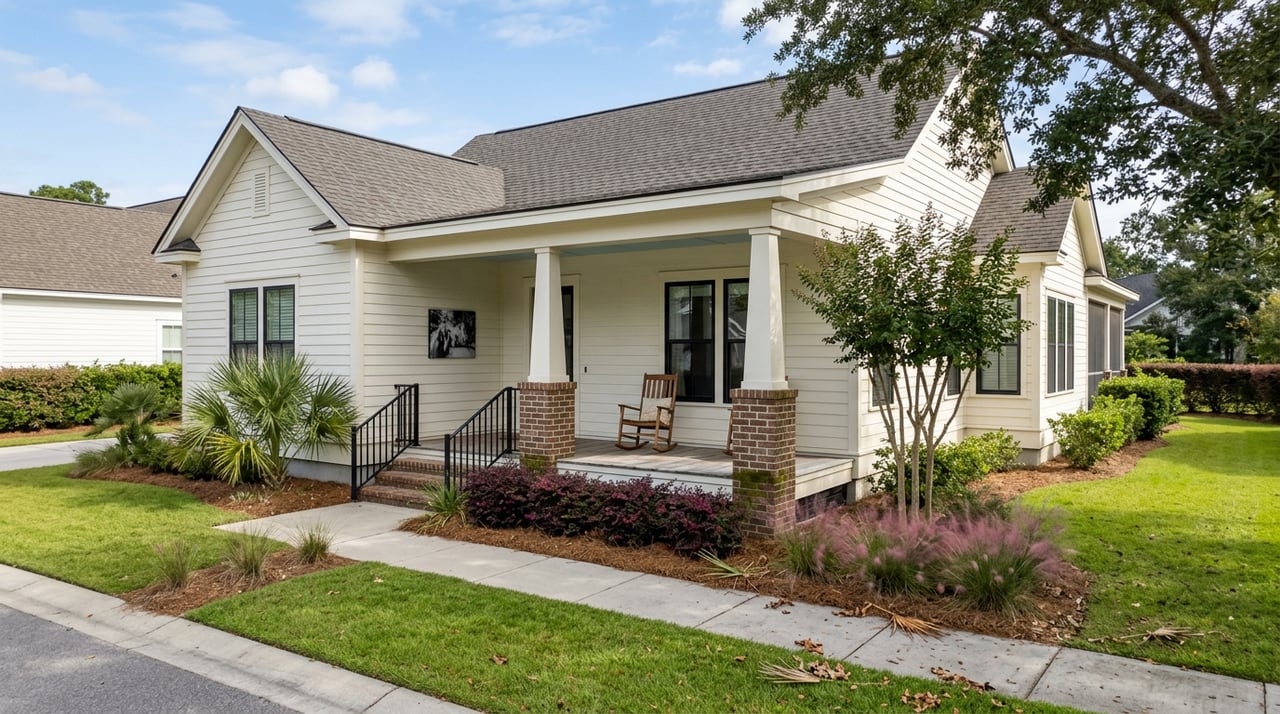
Cane Bay Plantation Golf Cart Trails: Beyond the Sidewalk
September 3, 2026
September 3, 2026
Saturday morning on the paved path near Cane Bay Elementary looks like it belongs to joggers and dog walkers, until a golf cart rolls past with a cooler strapped to the back seat and two kids in life jackets headed toward the lake. A minute later another cart merges in from a side street, this one carrying someone in work scrubs on their way to a shift. The runners step aside without looking up. Everyone here already knows what the path is actually for.
Cane Bay Plantation's trail system gets described in most write-ups as a walking and biking amenity, something you'd find in any master-planned brochure. That undersells it. The paths function as a second road network built for golf carts, one that pedestrians and cyclists share rather than the reverse. Once you look at the system through that lens, several design choices that seem incidental start to make sense.
More than 12 miles of paved, multi-use path already thread through Cane Bay, with a plan on file for 25 miles once the network is finished, according to Berkeley Outdoor Life's trail guide. The surface is concrete and asphalt, wide enough for strollers, and the guide is direct about who else is on it: many residents use golf carts on these same multi-use paths, and the recommended parking for anyone starting a walk or ride is The Market at Cane Bay at 1730 State Road, with overflow parking at the Cane Bay Elementary and Middle School lots on weekends.
That's the giveaway. A trail built purely for recreation doesn't need an official trailhead with dedicated overflow parking at two schools. A trail that doubles as a commuting route for kids getting to class, parents running errands, and neighbors visiting each other's sections does.
If the golf cart traffic were occasional or seasonal, you wouldn't expect a standing rental company to plant itself in the neighborhood. Cane Bay has one. OnPar Rides operates as Cane Bay Cart Rentals out of Summerville, offering standard four-seat carts and six-seat "limo" models seven days a week, according to its Yelp listing. A business built entirely around short-term cart access only survives if enough people are actually using carts as transportation rather than novelty. The fleet is evidence, not decoration.
The clearest proof of how seriously the cart-and-pedestrian network is engineered showed up this past New Year's morning, in the course design for the community's own race. The First Day 5K started at 9:26 a.m. in the Cane Bay Elementary School parking lot and used the paved path system to loop through two separate tunnels running under Cane Bay Boulevard, according to the race's official course description. Twice during the 3.1 miles, runners passed completely underneath the boulevard instead of crossing it at street level.
That's a real cost. Grading and building two pedestrian tunnels under a through road is not a cheap or casual decision, and it only gets made when planners expect enough foot and cart traffic to justify full separation from car traffic. But the same course description flags one spot where the tunnels don't apply: runners had to surface and cross the newer Nexton Parkway Extension at grade, with Berkeley County Sheriff's deputies stationed there specifically to manage that one crossing.
Put those two facts side by side and the pattern is obvious. Wherever Cane Bay's original trail system meets its own road network, it goes under. Wherever it meets a newer road built after the original plan, like the Nexton Parkway Extension, it still has to cross at street level with a deputy directing traffic. The tunnels aren't a nice-to-have. They're what happens when trail planning keeps pace with growth, and the at-grade crossing is what happens on the one morning a year the gap between old infrastructure and new construction actually gets tested.
None of this matters if there's nowhere to go. It turns out the destinations line up with the trailhead the trail guide already points you toward. The Market at Cane Bay, the Publix-anchored plaza sitting right where Highway 176 meets Cane Bay Boulevard, is both the recommended parking spot for the trail system and a working lineup of everyday stops:
A newer CAVA has also opened just outside the gates on North Creek Drive, adding to a food scene that keeps expanding at the edges of the original plan, a pattern confirmed independently by Yelp's own ranking of restaurants along Cane Bay Boulevard.
The Cane Bay Family YMCA rounds out the list of places worth the cart ride. It opened in 2019 as a 54,000 square foot facility with an indoor pool, a jogging track, a full basketball court, and after-school programming, and it's built around an unusual detail: a Berkeley County library branch operating inside the same building. Parents dropping kids at the pool can walk out with a stack of library books on the same trip. It's the kind of dual-purpose building that only makes sense in a neighborhood already organized around getting multiple errands done on one loop of the path.
None of this changes what Cane Bay looks like from the street. It changes what you assume the street is for. The trail wasn't built as a scenic add-on to the neighborhood. It was built as the second circulation system that carries the errands, school runs, and short commutes that a car would otherwise handle, which is why it has real trailheads, a rental economy, tunnels under the main boulevard, and a race course that has to work around all three.
If you already live along one of these paths, that's probably not news to you in the abstract. What might be worth noticing is how deliberately it was built, and how much of daily life here still runs on four wheels that never touch a highway.
If you're curious what a home near one of Cane Bay's trailheads is actually worth in today's market, Roslyn Kay Parker can walk you through it. Request a Free Home Valuation whenever you're ready to talk specifics.
Roslyn Kay is not your typical 9 to 5 Agent that waits on an opportunity for clients, she creates it! The time is now, let's make history together. Contact her today to find out how she can be of assistance to you!
Get In Touch With Me To Learn More
ROSLYN KAY PARKER
700 Nexton square Drive, Summerville, SC 29486