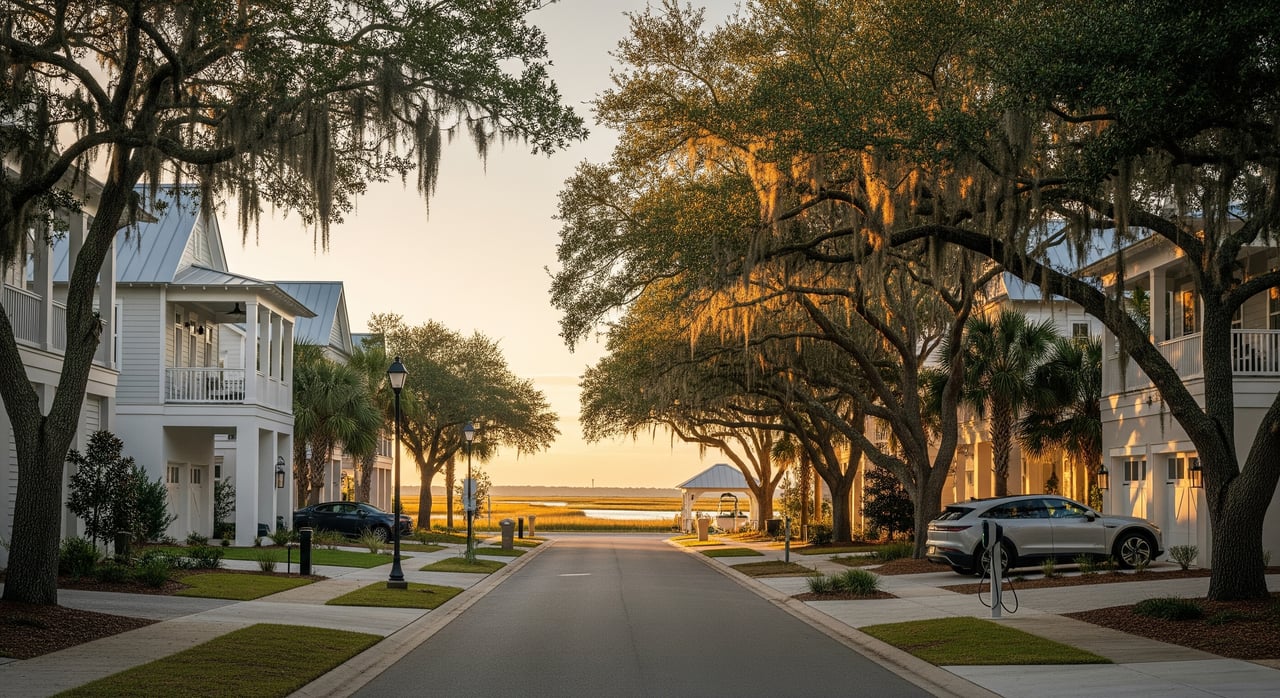
Is Cane Bay A Good Fit For Your Commute?
January 8, 2026
January 8, 2026
Your job might be in North Charleston, downtown Charleston, or near Joint Base Charleston, but your heart is set on Cane Bay Plantation. The big question is simple: will the commute fit your life? You are not alone in asking. Commute time and reliability shape daily routines, childcare, and stress levels.
In this guide, you will learn how Cane Bay’s location influences drive times, the routes most people use, when traffic is heaviest, and how to test your exact door-to-desk timing before you buy. You will leave with a clear, step-by-step framework to measure both the average and the worst days, so your decision is confident and data-driven. Let’s dive in.
Cane Bay Plantation sits in Berkeley County within the greater Charleston metro. It is part of the Summerville and Nexton corridor and relies on regional arterials to reach job centers. Most commutes funnel toward I-26, I-526, or key local connectors that feed into North Charleston, downtown Charleston, Mount Pleasant, and Joint Base Charleston.
To frame expectations, look at the U.S. Census Bureau’s American Community Survey for Berkeley County’s mean travel time to work. Treat that county baseline as context, then compare it to your door-to-desk timing using the testing steps in this guide. The county number is an average; your results will vary by address, work location, and schedule.
Across the region, traffic is most intense in the morning from about 7:00–9:00 AM and in the evening from about 4:00–6:30 PM. You should expect slower speeds and more day-to-day variability in these windows. Incidents on I-26 or near river crossings can create wider delays that affect several routes at once.
Average drive time does not tell the full story. Reliability matters. Plan to track a typical day, a busier day, and a worst observed day. The 90th-percentile time, or your longest observed trip in a test week, is a useful indicator of how the commute feels when things are not smooth.
Cane Bay residents often work in one of four employer clusters: aerospace and manufacturing, military, healthcare, and airport or logistics. Your route choice and variability will depend on where you land among these clusters.
If you work near Boeing or nearby suppliers, your commute often leans on I-26 with connector options to reach the plant area and adjacent industrial parks. These trips are usually among the shortest of the regional options from Cane Bay, but they are still sensitive to peak slowdowns and incidents on I-26. When traffic backs up, small crashes or lane closures can ripple across several miles.
Trips to the base or nearby facilities also lean on I-26 and key arterials. Build in extra time for base access procedures. The time from parking or gate clearance to your desk can be meaningful. Track both arrival and departure routines, since afternoon congestion can re-form around 4:00 PM and continue through 6:30 PM.
Reaching MUSC Health or downtown offices adds distance and river-crossing constraints. As you approach the peninsula, congestion on I-26 and bridge approaches can be a factor. Day-to-day variation is common, so test both your target arrival and a slightly earlier arrival to see if shifting your start by 15–30 minutes makes a noticeable difference.
Trips to Mount Pleasant or East Cooper hospitals will involve I-26, I-526, and bridge approaches. These river crossings are fixed points in the network and can become bottlenecks. You should compare multiple routing combinations and note which is more stable when there is an incident.
If you work at or near Charleston International Airport or port-related facilities, your time can be influenced by freight schedules and shift changes. Early morning departures can be smoother, while midday or afternoon changes may place you in peak return traffic. Test against your actual shift times.
Use this structured plan to measure door-to-desk time, variability, and real-life friction.
Several recurring patterns influence the Cane Bay commute.
Public transit coverage from Berkeley County into central Charleston is more limited than what you may find in dense urban cores. Regional bus service exists, but route availability and schedules change. Some larger employers and bases sponsor shuttles, vanpools, or ride-matching. Carpooling can help with HOV or preferred parking policies where offered. Biking is generally a last-mile solution due to distance and limited continuous infrastructure for long-haul trips from Cane Bay to downtown.
If you are considering transit or shuttles, do a complete test run. Account for parking at a park-and-ride, transfer times, schedule adherence, and the walk from stop to desk. Note whether shifting your start or end time by 15–30 minutes would improve reliability.
Use this to summarize your findings after testing.
These are common patterns you might test from Cane Bay. Your times will vary by address and schedule.
Cane Bay offers master-planned convenience, amenities, and access to the Summerville-Nexton corridor. The tradeoff is a drive that relies on major regional corridors. Your decision comes down to comfort with a typical day and tolerance for bad-day scenarios.
Set a personal threshold. Decide what is acceptable for most days and what you can tolerate on the worst days. If hybrid or flexible hours are possible, the commute equation often improves. If you must arrive at the height of peak traffic, give more weight to reliability in your analysis.
Cane Bay can be a strong fit if your job aligns with North Charleston or you have some flexibility in start and end times. Downtown and East Cooper roles may still work if you build in buffers and plan for variability. The only way to know is to test your route, measure door-to-desk time, and compare the results to your daily life.
If you want help planning test drives, comparing routes, or weighing locations within the community, reach out. As a local advisor with deep experience across Cane Bay, Nexton, and greater Summerville, I can help you map the options and choose with confidence. Connect with Roslyn Kay Parker to get started.
Roslyn Kay is not your typical 9 to 5 Agent that waits on an opportunity for clients, she creates it! The time is now, let's make history together. Contact her today to find out how she can be of assistance to you!
Get In Touch With Me To Learn More

ROSLYN KAY PARKER
700 Nexton square Drive, Summerville, SC 29486